

Nic Adler was standing on a corner of Ocean Way contemplating the new music festival he’s bringing to Santa Monica recently and while the small intersection is easy to miss on day to day activity, it would soon be mere steps from hundreds of thousands of music lovers.
"I was looking for a sign, for a name, or something to come to us as we were kind of going through this process, and looked up and saw Ocean Way, and it felt right," said Adler, senior vice president of regional festivals for Goldenvoice. Adler is also producing the Santa Monica show that will now be known as the Ocean Way Festival.
The name carries more than geographic convenience. Oceanway Recording Studio, founded by audio engineer Allen Sides, got its start in a three-car garage studio on that same small street before eventually relocating to Hollywood, where it hosted a long roster of recording artists over the years.
"It's a great name in general, but then it has this kind of tie back to something that's very Santa Monica and the history of Santa Monica music," Adler said.
The logistics
The Santa Monica City Council approved preliminary agreements to partner with Goldenvoice on a new annual beachfront music festival last year. Melissa Ormond, Goldenvoice's chief operating officer and COO of Festivals for AEG Presents, said at the time that partnering with the city to bring a festival to the Pier was "a true honor," and that the company could not wait to bring "world class music and artists" to the location.
The original concept called for an event drawing 30,000 to 35,000 attendees with 12 to 15 artists, returning annually in fall 2027 and fall 2028.
The exact dates have not been revealed nor has the lineup but a social media teaser for the show features the song People Everywhere (Still Alive) by Khruangbin.

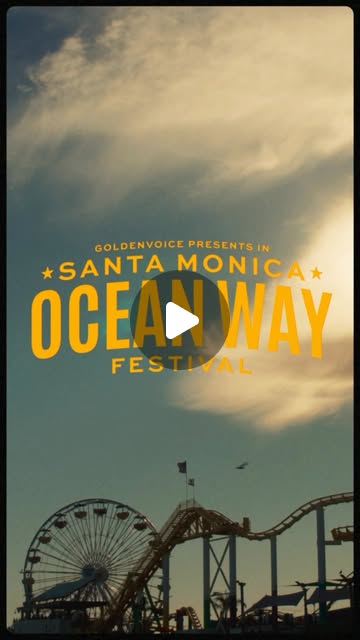
City staff have set a land-use license fee of approximately $1.34 million plus per-ticket revenue shares to the city. The footprint will use the beach, the Santa Monica Pier parking deck and portions of adjacent beach parking lots.
Adler characterized the festival as multi-genre and multi-generational. The main stage will sit at the base of the Pier facing south, a layout Adler said was chosen deliberately.
"What is that famous picture? What is the thing you envision when someone says Santa Monica Beach? And for me, it was the silhouette of the Pier with the sun behind it," Adler said. He said the show will take place entirely on the sand, distinct from the Pier-based Twilight Concert Series, though some logistics will involve the Pier.
Plans include a food component featuring Westside restaurants, a "beach club" area designed with input from Santa Monica-based designers or hospitality partners in place of a traditional VIP section and a farmers market-style vendor strip. Community programming will include a high school day and college day pairing students with industry professionals, free concerts at Reed Park and Tongva Park around the festival dates and beach cleanups with Heal the Bay. Adler said the festival's sustainability baseline exceeds the city's requirements for events, citing partnerships with waste-reduction company Three Squares and battery company Overdrive, which allows stages to run on solar-charged power.
A festival grown out of the city itself
What Adler describes, though, isn't simply a stage on a beach. It's an attempt to build a festival out of the raw material of Santa Monica as a place — its neighborhoods, its food culture, its design scene — rather than dropping a standard touring festival onto a scenic backdrop.
Adler said he and his team spent six months studying the city before settling on a creative direction, a process complicated by how fractured Santa Monica's identity can feel from block to block.
"It's so interesting how there's many different areas that are so defined that they almost feel like their own city within a city," Adler said. "It was — what parts of these do you take?"
He pointed to the Santa Monica farmers market as an example of something the festival is trying to capture rather than replicate with the sense of familiarity that exists between farmers and residents who often know each other on a first name basis. Adler said his team has been in talks with the farmers market about incorporating a vendor strip into the festival grounds designed to evoke that same feeling.
"I think that's something that is quintessential Santa Monica," Adler said.
That same instinct extends to food more broadly. Adler said the festival will lean into Westside restaurants and the current restaurant and bar scene, particularly along Montana Avenue, framing food as another form of the "discovery" people already expect from a music festival lineup where people come to the show expecting to experience different acts.
"Why is that just music?" Adler said. "I think there's this idea of discovery in music festivals... so what are these different pieces of Santa Monica that we can bring in where people are open to that discovery?"
Design will factor in as well. Rather than a traditional VIP section, the festival will include a "beach club" area that Adler said may be designed by local designers or in partnership with a Santa Monica hotel or restaurant, rather than built to a generic festival template.
Underlying all of it is a broader civic narrative Adler returned to repeatedly: the idea that Santa Monica, despite having had plenty of cultural moments historically, hasn't had one recently in the way neighborhoods like West Hollywood, Highland Park or Silver Lake have.
"It seems like there's some new folks at the city that have a vision," Adler said. He framed the festival as a response to a city navigating financial and reputational strain, arguing that the festival can offer something concrete during a difficult stretch. "I think the city is turning to music to turn a corner."
Partnering with the community
Adler said the festival's relationship with Santa Monica is meant to extend well beyond the event weekend itself, describing plans for a high school day and a college day that would pair students with festival managers, marketing staff, musicians and sustainability experts, alongside internship opportunities. The festival will also fund free concerts at Reed Park and Tongva Park around the festival dates, and beach cleanups conducted with Heal the Bay.
On sustainability, Adler said the festival's baseline already exceeds what the city requires of events, pointing to partnerships with waste-reduction company Three Squares and battery company Overdrive, which allows festival stages to run on solar-charged power.
Adler said Goldenvoice also intends to prioritize local vendors and contractors where possible — a Santa Monica-based printing company over one in Los Angeles, a Westside public relations firm over one in New York — as a matter of principle rather than obligation.
"By making those types of decisions, we're guided by the right principles, and it's going to help us long term with staying connected to Santa Monica in the right way," Adler said.
He pointed to Goldenvoice's existing festivals near the Rose Bowl in Pasadena, held within a residential neighborhood, as a template for the kind of ongoing relationship the company hopes to build with residents here — one built on listening and adjusting rather than a single successful launch.
"I would say Goldenvoice is pretty good at listening and making the right changes in real time, and understanding that this is where someone lives," Adler said. "The more that we can always remember where this festival started, I think, will help guide us with a lot of the things that we do at the show."