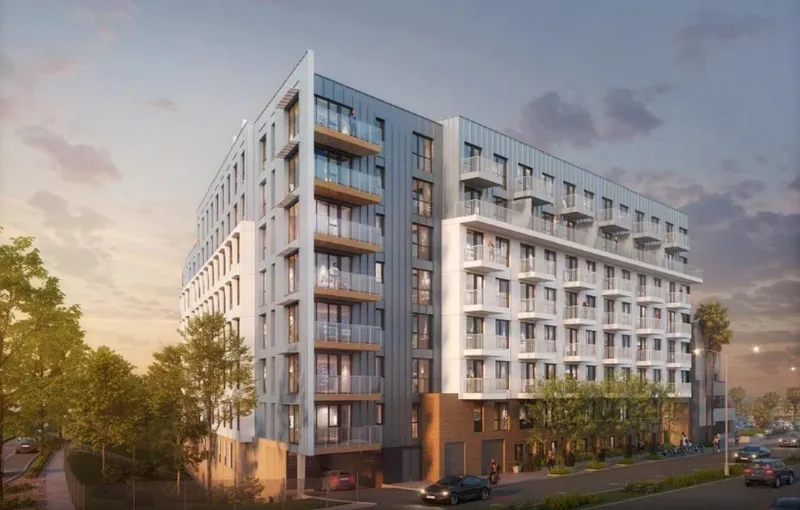
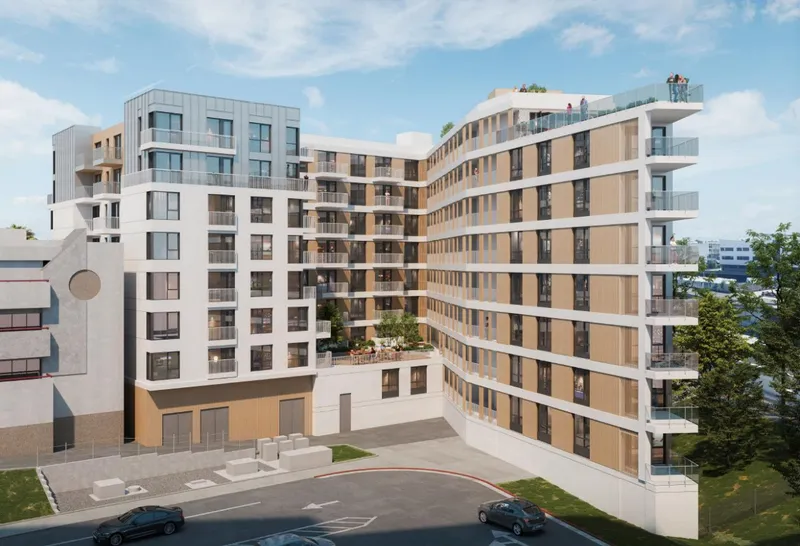
The Santa Monica Architectural Review Board continued its review of a proposed 132-unit residential building this month after board members raised concerns about the building's corner design and materials at the prominent gateway site near the freeway.
The eight-story, 87-foot-tall project at 1640 5th Street would include 15 affordable units and sit on an irregularly shaped parcel adjacent to the I-10 freeway and near the Downtown Santa Monica Metro Station, making it highly visible to people entering the city.
After extensive discussion, all seven board members voted to continue the project rather than approve it, citing the need for additional design refinements despite acknowledging improvements since the project's previous review in April.
"I think it's gone in a really good direction, but I think I'd like to see it come back so that we could really see how those two things are actually explored and resolved," said board member Craig Hamilton.
The board's primary concerns centered on the building's corner treatment, particularly at the southeast intersection of 5th Street and Olympic Boulevard. Board members struggled with whether the design should read as a single corner building or two separate structures that meet at an intersection.
"I don't think there's a fatal flaw anywhere that we're talking about. But I do feel like it's a little bit out of reach of the kind of thing we'd just be able to say, work with the staff on this," said board member Kevin Daly. "I feel like this is a number of things that the designer needs to pull together to make it kind of really click."
Materials also drew significant scrutiny, particularly the applicant's proposal to use brick on the lower floors.
"I don't see quite why it would be brick. There's no brick in the city. I would prefer something like wood or something, possibly a little bit warmer," said board member Barbara Coffman.
The project, developed by Lincoln Property Company, would maximize the site's potential by conforming to the irregular "L" shaped parcel. It includes three levels of subterranean parking and uses the State Density Bonus program to exceed normal height and floor area ratio limits by including affordable housing units.
Board members acknowledged the project's significance as a gateway to Santa Monica. Chair Patrick Tighe noted the building's prominence from the freeway approach, saying the design strategy of "letting something slide by" rather than creating a traditional corner treatment was "actually a good move."
"The idea of not really resolving the corner, but by letting something slide by, is actually a good strategy," Tighe said.
The applicant had made several changes since the April review, including redesigning the southeast corner, replacing fiber cement board with brick, adding solar shading elements, and revising the roofline for consistency. However, board members felt more comprehensive refinement was needed.
"I think that the project is much better than it was when we first thought so. I really appreciate that," said Coffman, while suggesting additional modifications including possible balconies for second-floor units.
Board member Li emphasized the importance of the building's nighttime appearance, calling for more innovative lighting design.
"I think many so like on that side, if we can just try to be more innovative, and I think it will really help to improve the overall presence of the building facing the public," Qianyu Li said.
The meeting also featured the introduction of new Community Development Director Arminé Chaparyan, who brings more than 24 years of local government experience to the role. Chaparyan, who previously served as city manager for South Pasadena, noted she had met with 165 individuals during her first four months on the job.
"I'm sure you all know we're in the midst of a very challenging budget process, and that, coupled with wanting to do quite a bit on the economic development recovery side, it's keeping all of us busy," Chaparyan told the board. "I want to thank you for the extensive amount of time you give us. It's the greatest volunteer work any of you would do."
The project will return to the Architectural Review Board for another hearing after the applicant addresses the board's concerns. No date was set for the continued review.
Under the Housing Accountability Act, the board cannot impose conditions that would reduce the number of residential units or residential density of the project, though it retains authority over design elements.