
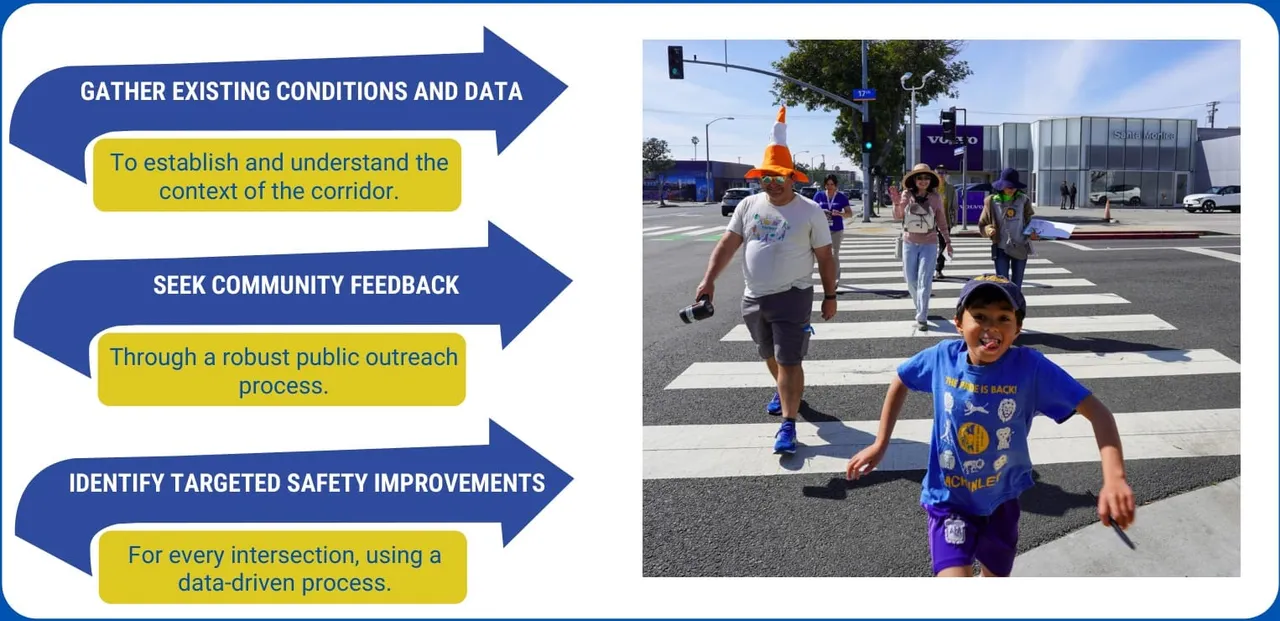
The City Council unanimously sent back a proposed safety plan for Santa Monica Boulevard on Tuesday, directing staff to return within 60 days with revisions that prioritize pedestrian and cyclist safety over vehicle throughput.
The Santa Monica Boulevard Safety Study, funded by a Caltrans grant, analyzed 10 years of crash data along the 2.4-mile corridor stretching from Ocean Avenue to Centinela Avenue. The study documented 435 injury crashes between 2015 and 2024, including one fatality and 30 severe injuries.
Council members said the proposal failed to align with the city's Vision Zero commitment to eliminate traffic deaths.
"Safety needs to take precedence in what we're seeing here," Mayor Caroline Torosis said. "I just, quite frankly, did not totally feel that commitment in some of the trade-offs that were mentioned."
The data revealed pedestrians are disproportionately affected by the most serious crashes, accounting for 29 percent of fatal and severe injury incidents despite representing only 11 percent of all crashes. Adults over 65 make up 23 percent of pedestrians involved in injury crashes.
Councilmember Dan Hall delivered pointed criticism of the proposal, citing his own experience living near the corridor.
"I used to live two buildings away from the intersection of Santa Monica and Yale, and one day I was working in my home office when I heard a crash so violent that the window to my office shook," Hall said, describing a speeding driver who struck a palm tree and careened into a bus stop.
Hall said he would not vote to approve the plan as presented.
"If an improvement reduces the likelihood of someone being killed or seriously injured, but reduces vehicle throughput, we support that improvement," he said. "No safety countermeasure will be eliminated because it worsens vehicular throughput."
The council's motion directs staff to incorporate several specific changes, including reducing lane widths to approximately 10 feet, exploring raised crosswalks at unsignalized intersections, moving all bus stops to far-side locations where feasible, and extending bus-only lanes in the downtown area.
Council members expressed particular concern about the Chelsea Avenue intersection near McKinley Elementary School. The original proposal placed a new pedestrian signal and median refuge island at that location in Phase 2, which could take up to 10 years to implement. The council directed staff to prioritize those improvements in Phase 1 and identify funding from the capital improvement budget if necessary.
"I wish it could be done today, because my kids are there right now," said Carlos Hernandez, senior transportation planner, summarizing feedback he received from parents during community outreach.
The study found that 85th percentile speeds in the eastern portion of the corridor range from 35 to 49 miles per hour, well above the posted speed limit. Councilmember Jesse Zwick questioned why some lane widths remained above 12 feet despite previous council direction to narrow them.
Staff acknowledged that certain safety features were scaled back due to concerns about vehicle level of service. A proposed pedestrian scramble at 20th Street was replaced with protected left turns after simulations showed drivers might have to wait through multiple signal cycles.
Councilmember Natalya Zernitskaya referenced the book "There Are No Accidents by Jessie Singer," noting the city should design streets with distracted users in mind.
"We can make roadways safer by designing them with the lowest common denominator user in mind," she said, "to make sure that they don't get a chance to make an inadvertent mistake that can hurt or kill someone."
The total estimated cost for all proposed improvements is approximately $11 million. Staff indicated Phase 1 improvements could be coordinated with planned repaving of the boulevard before the 2028 Olympic Games.
City Manager Oliver Chi said staff would synthesize the council's feedback and could return sooner than 60 days with updated concepts while continuing design work on elements that received consensus support.
Multiple community organizations submitted comments on the proposal, with groups including Santa Monica Forward and Santa Monica Families for Safe Streets calling for stronger safety measures, while a local auto dealership owner requested further consultation about impacts to business access.