
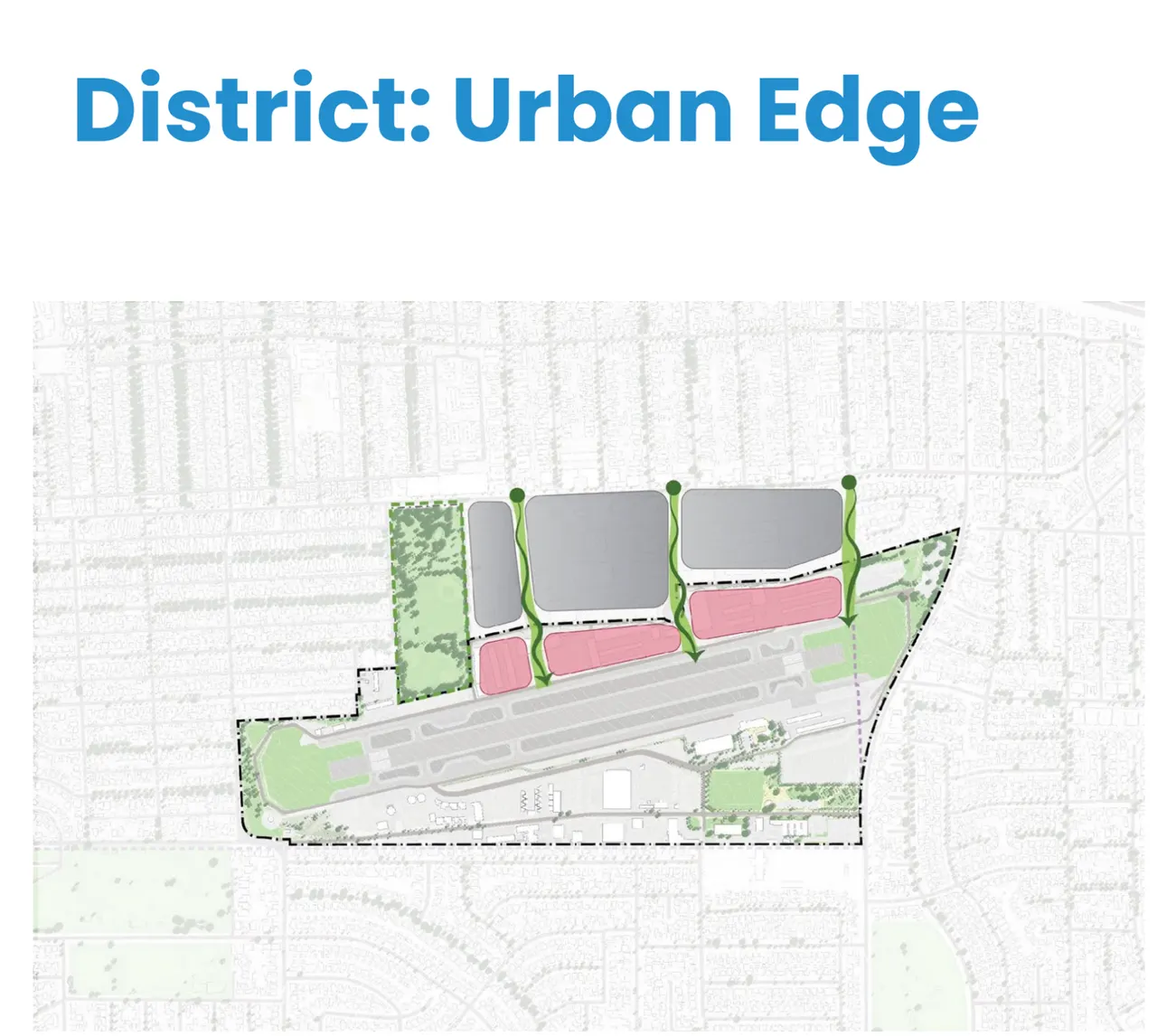
Santa Monicans for Renters’ Rights is urging the Santa Monica City Council to designate a portion of the future Santa Monica Airport park for 3,000 units of below-market-rate housing, arguing that the area known as the “Urban Edge” in the city’s own planning documents is the most logical and least disruptive place to build.
In an April 22 letter to the council, SMRR co-chairs Denny Zane and Mike Soloff said the group’s vision for affordable housing on the 192-acre airport site has increasingly focused on the roughly 30-acre Urban Edge zone — a strip north of the runways that is currently devoted entirely to aviation-dependent uses and would become available once the airport closes at the end of 2028.
“The uses proposed for the Urban Edge in the Draft Framework Diagram, while attractive, already have a strong presence in our community and do not rise to the same level of need as below-market-rate housing,” the letter states, taking aim at the diagram’s proposed uses for the area, which include farmers markets, brew gardens and branch libraries.
SMRR’s proposal asks the council to direct city staff and consultants to include the development of 3,000 below-market-rate units in the Environmental Impact Report alternatives analysis. The group also called on the EIR to assess whether the Urban Edge zone should be expanded to accommodate parking and circulation infrastructure.
The letter noted that the Urban Edge’s northern boundary abuts the old Santa Monica Business Park, now owned by Boston Properties, which has announced plans for a 385-unit, eight-story market-rate housing project at 28th Street and Ocean Park Boulevard. SMRR argued that below-market-rate housing in the Urban Edge area would serve as a natural buffer between that development and the broader park.
The group also cited traffic concerns, noting that ingress and egress from the Urban Edge can be routed to Ocean Park Boulevard, reducing pressure on Walgrove Avenue and 23rd Street.
A Fractured Coalition
SMRR’s push comes amid a broader and increasingly contentious debate over what role, if any, housing should play on the airport site. In January 2026, housing advocates affiliated with SMRR and UNITE HERE Local 11 submitted language for a November 2026 ballot measure that would amend Measure LC — the 2014 city charter amendment that restricts post-closure use of the property to parks and open space — to allow up to 3,000 units of largely affordable housing on up to 25% of the site.
That proposal drew swift opposition from both parks supporters and some of the city’s progressive political organizations who have argued the housing initiative could fracture the coalition that has spent decades working to close the airport and convert it to parkland.
Pro-aviation interests have added a separate layer of opposition to the closure itself. The Aircraft Owners and Pilots Association and the group Spirit of Santa Monica have argued the airport is a regional asset and emergency resource, pointing to a fall 2025 poll showing 67% of surveyed voters favored keeping it open.
The City’s most ardent supporters of parkland at the Airport denounced the new SMRR letter saying it is intended to upend the entire airport to park conversion project.
“Under standard planning procedures decisions about alternatives in an EIR don’t come until a preferred project plan has been developed. This is not going to happen with the Airport Conversion Project until after its Phase 5, sometime next year,” said a statement by Santa Monica Airport2Park Foundation and the Santa Monica Great Park Coalition. “Given that SMRR and its allies have chosen to ignore the Conversion Project, it’s not surprising that SMRR is now asking the City Council to break into that process and mandate the study of a particular plan of housing in the EIR.”
The statement said SMRR’s letter was disingenuous given that SMRR is still gathering signatures for a ballot measure that would require that 25 percent of the airport land, nearly 50 acres, be used for housing.
“It’s also asking the council to do something that would possibly violate CEQA because housing at the airport is not legally permissible, and thus infeasible, given that it is inconsistent with the language Measure LC added to the City Charter,” said the statement.
SMRR, for its part, sought to address the closure question directly in its letter, arguing that a united front between park and affordable housing advocates is the best defense against any effort to reverse the closure.
The Road to Closure
Santa Monica Airport, a general aviation field that has operated since World War I, could cease operations at midnight on Dec. 31, 2028, under a 2017 consent decree the city reached with the Federal Aviation Administration. The closure follows nearly half a century of legal and political effort by the city.
Active planning for the post-airport site has accelerated in recent years. The city has run a multi-phase public outreach process that has included 87 public meetings and more than 12,100 online survey responses. In early 2026, the city released a Draft Framework Diagram organizing the site into eight interconnected districts. A preferred scenario will inform the CEQA environmental review required before implementation can begin.
The city has also secured a $499,149 Los Angeles County grant to begin design on an initial 20-acre segment of the future park.
Centennial Picnic Planned
As the planning debate continues, the Santa Monica Great Park Coalition is marking a milestone with a community picnic in Clover Park from noon to 2:30 p.m. on Saturday, April 25.
The event celebrates the centennial of Santa Monica’s 1926 parks bond, when roughly 30,000 residents voted to tax themselves the equivalent of $16 million in today’s money to acquire land for the city’s first Great Park — land that was later absorbed into the Douglas Aircraft plant and ultimately became the airport.
The coalition will provide free hot dogs, cold drinks and cupcakes. Activities will include face painting, art and sports activities, a pollinator-attracting plant giveaway and a “Dogs of the Great Park” photo spot.
editor@smdp.com